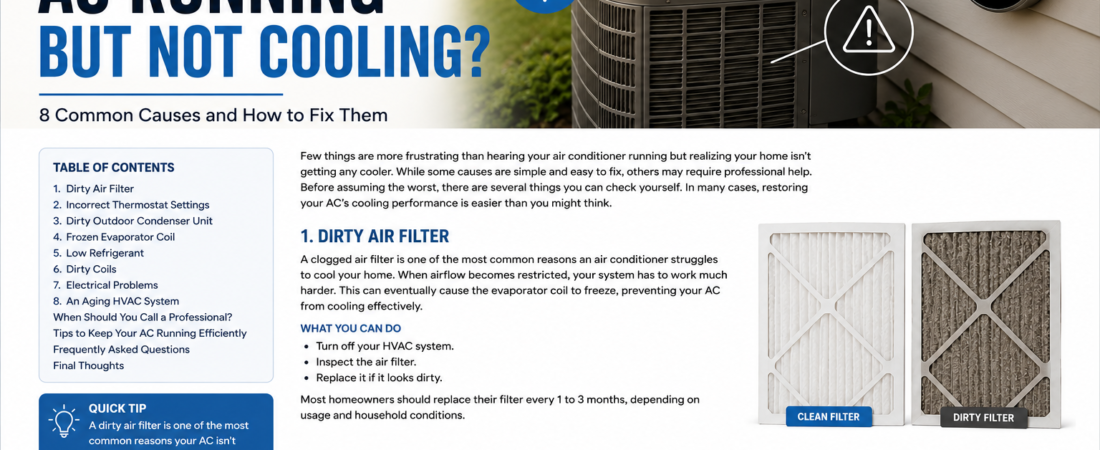
Is your air conditioner running but your home still feels warm? This is one of the most common HVAC problems homeowners experience, especially during the hottest months of the year. The good news is that many cooling issues have simple explanations and can sometimes be resolved without calling a technician.
Before assuming your air conditioner needs an expensive repair, there are several things you can check yourself. In this guide, we’ll cover the most common reasons your AC is running but not cooling and what you can do to fix the problem.
1. Dirty Air Filter
A clogged air filter is one of the leading causes of poor cooling performance.
When the filter becomes packed with dust, pet hair, and debris, it restricts airflow throughout your HVAC system. Reduced airflow forces your air conditioner to work harder and can even cause the evaporator coil to freeze.
What You Can Do
- Turn off your HVAC system.
- Remove the air filter.
- Inspect it for dirt and dust buildup.
- Replace it if it looks dirty.
Most homeowners should replace their air filter every 1–3 months.
2. Incorrect Thermostat Settings
Sometimes the problem is much simpler than people expect.
Double-check that:
- The thermostat is set to Cool.
- The fan is set to Auto instead of On.
- The temperature is set below the current room temperature.
- The thermostat batteries are still working (if applicable).
These quick checks can save unnecessary troubleshooting.
3. Dirty Outdoor Condenser Unit
Your outdoor AC unit removes heat from inside your home.
If leaves, grass, dirt, or other debris block the condenser, your system cannot release heat efficiently.
What You Can Do
- Turn off power to the unit.
- Remove leaves and debris around the condenser.
- Gently rinse the exterior with a garden hose.
- Keep at least two feet of clearance around the unit.
Never use a pressure washer because it can damage the delicate cooling fins.
4. Frozen Evaporator Coil
Restricted airflow or other HVAC issues can cause the evaporator coil to freeze.
Signs include:
- Ice on refrigerant lines
- Ice around the indoor unit
- Weak airflow
- Warm air coming from vents
What You Can Do
Turn the system off and allow the ice to melt completely before restarting it.
If the coil freezes again after replacing the filter, it’s time to call an HVAC professional.
5. Low Refrigerant
Air conditioners do not consume refrigerant like gasoline.
If refrigerant is low, there is usually a leak somewhere in the system.
Common signs include:
- Warm air from vents
- Ice forming on refrigerant lines
- Hissing sounds
- Long cooling cycles
A licensed HVAC technician should locate and repair the leak before recharging the system.
6. Dirty Evaporator or Condenser Coils
Over time, both indoor and outdoor coils collect dirt.
Dirty coils reduce the system’s ability to transfer heat, making your air conditioner less efficient while increasing energy costs.
Routine maintenance helps prevent this problem.
7. Electrical Problems
Your AC relies on several electrical components.
Possible issues include:
- Failed capacitor
- Faulty contactor
- Tripped breaker
- Blown fuse
- Loose wiring
If your outdoor unit won’t turn on or repeatedly trips the breaker, professional service is recommended.
8. An Aging HVAC System
Most central air conditioning systems last between 15 and 20 years with proper maintenance.
As they age, they naturally lose efficiency and require more frequent repairs.
If your unit is nearing the end of its lifespan, replacing it may be the most cost-effective solution.
When Should You Call an HVAC Professional?
Contact a qualified technician if:
- The AC continues blowing warm air after replacing the filter.
- Ice continues forming on the system.
- The outdoor unit won’t start.
- You suspect a refrigerant leak.
- The breaker keeps tripping.
- You notice burning smells or unusual noises.
Prompt repairs can prevent additional damage and help restore your home’s comfort.
Tips to Keep Your AC Running Efficiently
Preventive maintenance is the best way to avoid cooling problems.
Helpful habits include:
- Replace your air filter regularly.
- Keep the outdoor condenser clean.
- Schedule annual HVAC maintenance.
- Keep supply and return vents unobstructed.
- Check your thermostat settings before every cooling season.
Regular maintenance can improve efficiency, lower utility bills, and extend the life of your HVAC system.
Frequently Asked Questions
Why is my AC running but only blowing warm air?
The most common causes include a dirty air filter, thermostat problems, frozen coils, low refrigerant, or a dirty outdoor condenser.
Can a dirty air filter stop my AC from cooling?
Yes. A clogged filter restricts airflow and can reduce cooling performance or even cause the evaporator coil to freeze.
Should I turn my AC off if it’s frozen?
Yes. Turn the system off and allow the ice to melt completely before restarting it.
How often should my AC be serviced?
Most HVAC professionals recommend having your air conditioning system inspected once a year before summer begins.
Final Thoughts
If your air conditioner is running but not cooling, don’t panic. Many cooling problems are caused by simple issues such as a dirty air filter, incorrect thermostat settings, or a blocked outdoor condenser.
However, if these basic troubleshooting steps don’t solve the problem, contacting a qualified HVAC technician is the safest option. Addressing small problems early can prevent expensive repairs and help keep your home comfortable throughout the summer.
A well-maintained air conditioner not only cools your home more effectively but can also save money on energy bills and extend the life of your HVAC system.