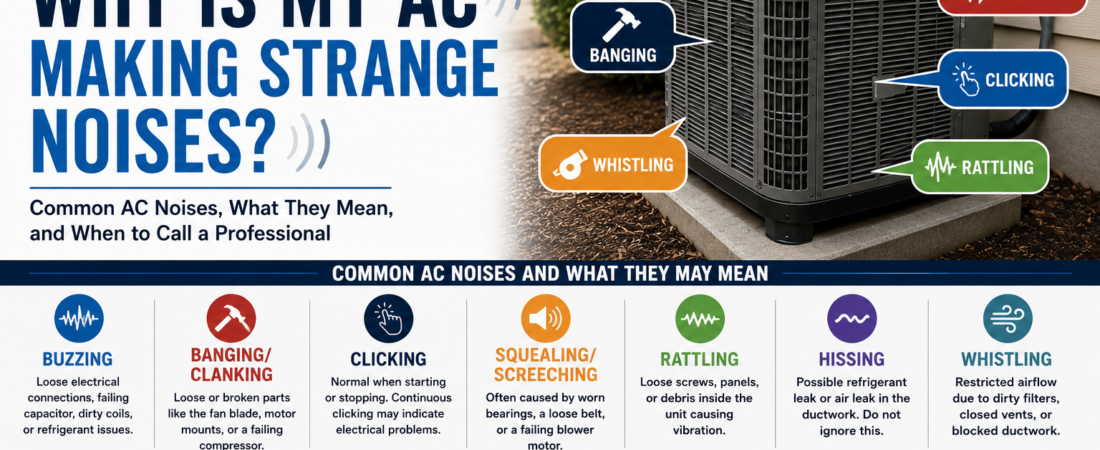
Your air conditioner should operate relatively quietly. While it’s normal to hear a gentle hum when your system starts, loud or unusual noises often indicate that something isn’t working properly.
Ignoring these sounds can lead to more expensive repairs, so it’s important to identify the problem as early as possible.
In this guide, we’ll explain the most common AC noises, what they usually mean, and when you should contact an HVAC professional.
Buzzing Noise
A buzzing sound is one of the most common AC complaints.
Possible causes include:
- Loose electrical wiring
- Failing capacitor
- Dirty condenser coil
- Refrigerant issues
- Loose parts inside the unit
If the buzzing becomes louder or your system isn’t cooling properly, it’s a good idea to have it inspected.
Banging or Clanking
A loud banging sound often means something has come loose inside the outdoor unit.
Possible causes include:
- Loose fan blade
- Broken blower wheel
- Failing compressor
- Loose motor components
Turn the system off if you hear repeated banging to prevent additional damage.
Clicking
It’s normal to hear one or two clicks when your system starts or stops.
However, continuous clicking may indicate:
- Faulty thermostat
- Electrical relay problem
- Bad control board
- Failing capacitor
Repeated clicking without the system starting should be inspected by a technician.
Squealing or Screeching
High-pitched squealing often points to moving parts.
Common causes include:
- Worn blower motor bearings
- Loose fan belt (older systems)
- Failing blower motor
These problems usually require professional service.
Rattling
Rattling noises are often caused by loose hardware.
Check for:
- Loose screws
- Debris inside the outdoor unit
- Loose access panels
- Small sticks or rocks near the fan
Sometimes a simple tightening of screws solves the problem.
Hissing
A hissing sound should never be ignored.
Possible causes include:
- Refrigerant leak
- Leaking air duct
- Internal valve leak
If you suspect a refrigerant leak, turn off the system and contact an HVAC professional.
Whistling
Whistling usually indicates an airflow problem.
Common causes include:
- Dirty air filter
- Closed air vents
- Blocked return vents
- Undersized ductwork
Replacing the air filter often resolves this issue.
When Should You Call a Professional?
Schedule HVAC service if:
- The noise suddenly becomes much louder.
- The AC stops cooling properly.
- You hear metal scraping.
- You smell something burning.
- The breaker trips repeatedly.
- You suspect a refrigerant leak.
Prompt repairs can prevent larger and more expensive problems.
How to Prevent AC Noise Problems
Routine maintenance is the best way to keep your air conditioner running quietly.
Helpful tips include:
- Replace your air filter every 1–3 months.
- Schedule annual HVAC maintenance.
- Keep the outdoor condenser clean.
- Remove leaves and debris around the unit.
- Tighten loose screws if you notice vibration.
Simple maintenance can significantly extend the life of your HVAC system.
Frequently Asked Questions
Is it normal for my AC to make noise?
Yes. A quiet hum and occasional click are normal. Loud banging, screeching, buzzing, or hissing noises are not.
Why is my AC making a loud buzzing noise?
Buzzing can indicate electrical problems, a failing capacitor, loose parts, or refrigerant issues.
Should I turn my AC off if it’s making loud noises?
Yes. If the noise is sudden, loud, or sounds like metal scraping or banging, turn the system off and have it inspected.
Final Thoughts
Strange noises are often your air conditioner’s way of telling you something needs attention. While some sounds may have simple causes, others can signal serious mechanical or electrical problems.
Addressing unusual noises early can help prevent expensive repairs, improve your system’s efficiency, and keep your home comfortable throughout the cooling season.
If you’re ever unsure about a new sound coming from your HVAC system, it’s always safer to have it inspected by a qualified technician.