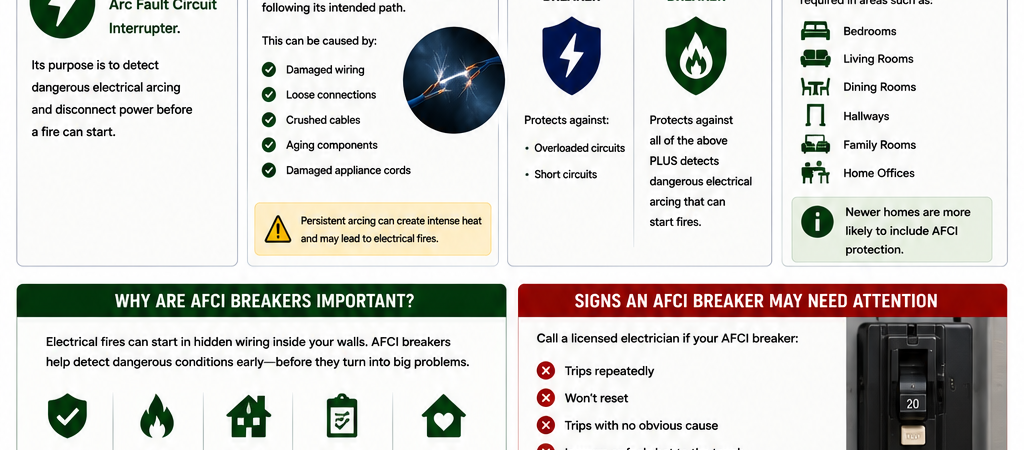
Modern homes include several safety devices designed to protect both people and property. While many homeowners have heard of GFCI outlets, fewer are familiar with Arc Fault Circuit Interrupter (AFCI) breakers.
These devices play an important role in reducing the risk of electrical fires by detecting dangerous electrical conditions that traditional circuit breakers may not recognize.
Understanding how AFCI breakers work can help homeowners better understand one of the most important safety features in today’s electrical systems.
What Does AFCI Stand For?
AFCI stands for Arc Fault Circuit Interrupter.
Its purpose is to detect dangerous electrical arcing and disconnect power before the arc has an opportunity to generate enough heat to ignite nearby materials.
Unlike standard breakers, AFCIs are specifically designed to identify certain types of electrical faults associated with wiring problems.
What Is an Electrical Arc?
An electrical arc occurs when electricity jumps between conductors instead of following its intended path.
Arcing can result from:
- Damaged wiring
- Loose electrical connections
- Crushed electrical cables
- Aging electrical components
- Damaged appliance cords
Although some electrical arcing is harmless, persistent or unintended arcing can create enough heat to become a fire hazard.
How Are AFCI Breakers Different From Standard Breakers?
A traditional circuit breaker primarily protects against:
- Overloaded circuits
- Short circuits
An AFCI breaker also monitors the electrical waveform for patterns associated with dangerous arcing.
This allows it to provide an additional layer of protection beyond what a standard breaker offers.
Where Are AFCI Breakers Commonly Used?
Building codes have expanded AFCI protection over the years.
Depending on local requirements and the age of the home, AFCI protection may be found in areas such as:
- Bedrooms
- Living rooms
- Dining rooms
- Hallways
- Family rooms
- Home offices
Newer homes are generally more likely to include AFCI protection than older homes.
Why Are AFCI Breakers Important?
Electrical fires can begin inside walls where damaged wiring may go unnoticed.
AFCI breakers help reduce this risk by detecting certain dangerous electrical conditions before they develop into larger problems.
Benefits include:
- Improved electrical safety
- Reduced fire risk
- Protection for hidden wiring
- Compliance with many modern building codes
- Greater peace of mind for homeowners
Signs an AFCI Breaker May Need Attention
An AFCI breaker may require professional evaluation if:
- It trips repeatedly.
- It will not reset.
- It trips without an obvious cause.
- Other electrical warning signs are present.
Repeated tripping does not always mean the breaker is defective. It may indicate an underlying electrical issue that should be investigated.
Frequently Asked Questions
Are AFCI breakers required in every home?
Requirements vary depending on the home’s age, location, and local building codes. Newer homes are generally more likely to include AFCI protection.
What’s the difference between AFCI and GFCI protection?
AFCI devices are designed to help reduce the risk of electrical fires caused by dangerous arcing, while GFCI devices help reduce the risk of electrical shock by monitoring current flow.
Can an AFCI breaker trip even if nothing seems wrong?
Yes. Repeated tripping may indicate a wiring issue, a damaged appliance, or another electrical condition that requires professional evaluation.
Final Thoughts
AFCI breakers are one of several important safety features found in many modern homes. By detecting potentially dangerous electrical arcing, they provide an additional layer of protection that standard breakers alone may not offer.
Understanding the purpose of AFCI technology can help homeowners better appreciate how modern electrical systems are designed to improve safety and reduce the risk of electrical fires. If an AFCI breaker repeatedly trips or shows signs of malfunction, it’s best to have the electrical system evaluated by a licensed electrician.