A dripping faucet may seem like a small problem, but over time it can waste hundreds of gallons of water and increase your monthly utility bill. Fortunately, many faucet leaks are caused by worn-out parts that can be replaced with basic tools.
In this guide, you’ll learn what causes faucets to leak, how to fix them, and when professional plumbing help may be necessary.
Why Is My Faucet Leaking?
Most faucet leaks are caused by normal wear and tear.
Common causes include:
- Worn rubber washers
- Damaged O-rings
- Worn valve cartridges
- Loose packing nuts
- Mineral buildup from hard water
The good news is that many of these issues are inexpensive to repair.
Tools You’ll Need
Before getting started, gather:
- Adjustable wrench
- Phillips screwdriver
- Flathead screwdriver
- Replacement cartridge or washers
- Plumber’s grease
- Clean towel
- Small bucket
Having everything ready will make the repair much easier.
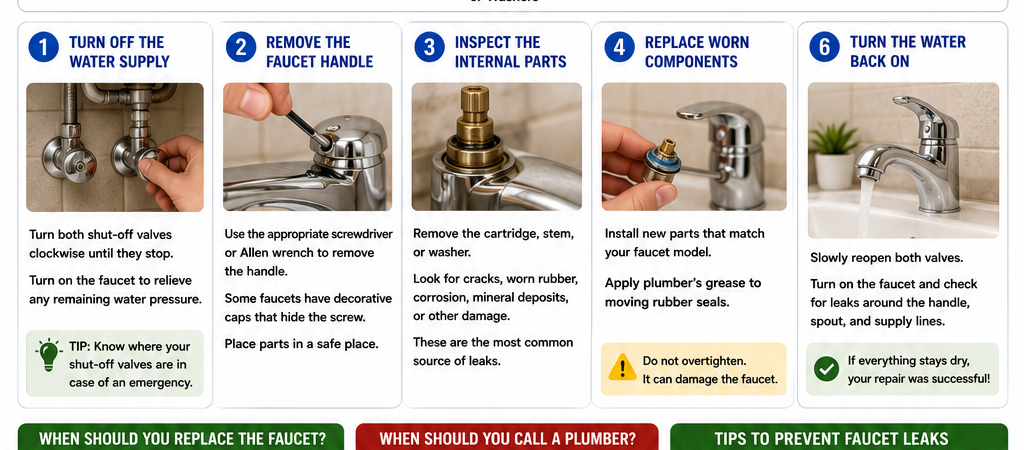
Step 1: Turn Off the Water Supply
Locate the shut-off valves beneath the sink.
Turn both valves clockwise until they stop.
Turn on the faucet afterward to relieve any remaining water pressure.
Step 2: Remove the Faucet Handle
Use the appropriate screwdriver or Allen wrench to remove the handle.
Some faucets have decorative caps that hide the mounting screw.
Place small parts in a safe location so nothing gets lost.
Step 3: Inspect the Internal Parts
Carefully remove the cartridge, stem, or washer depending on your faucet style.
Look for:
- Cracked rubber washers
- Torn O-rings
- Corrosion
- Mineral deposits
- Worn cartridges
These parts are the most common source of leaks.
Step 4: Replace Worn Components
Install new replacement parts that match your faucet model.
Apply a small amount of plumber’s grease to moving rubber seals before reassembly.
Avoid overtightening components, which can damage the faucet.
Step 5: Reassemble the Faucet
Reinstall all components in the reverse order.
Double-check that each part is seated correctly before tightening.
Step 6: Turn the Water Back On
Slowly reopen both shut-off valves.
Turn on the faucet and inspect carefully for leaks around:
- The handle
- The spout
- Supply line connections
If everything stays dry, your repair was successful.
When Should You Replace the Faucet?
Sometimes replacement makes more sense than repair.
Consider replacing the faucet if:
- It has severe corrosion.
- Replacement parts are unavailable.
- The faucet leaks repeatedly.
- The finish is badly damaged.
- It’s more than 15–20 years old.
Modern faucets are often more water-efficient and easier to maintain.
When Should You Call a Plumber?
Call a licensed plumber if:
- The leak continues after replacing parts.
- The shut-off valves don’t work.
- Water is leaking under the sink.
- The faucet body is cracked.
- You’re uncomfortable disassembling the faucet.
Professional repairs can prevent additional water damage.
Tips to Prevent Faucet Leaks
Simple maintenance can help extend the life of your faucet.
Helpful habits include:
- Avoid overtightening faucet handles.
- Clean mineral deposits regularly.
- Inspect supply lines yearly.
- Repair small drips early.
- Replace worn washers before they fail completely.
Frequently Asked Questions
Can a dripping faucet increase my water bill?
Yes. Even a slow drip can waste hundreds or even thousands of gallons of water over the course of a year.
Is fixing a faucet difficult?
Many faucet repairs are beginner-friendly and require only basic hand tools.
How long do faucet cartridges last?
Most faucet cartridges last 10–20 years, depending on water quality and how often the faucet is used.
Final Thoughts
A leaking faucet is one of the easiest plumbing problems many homeowners can fix themselves. Replacing worn washers, O-rings, or cartridges often solves the issue and helps conserve water.
By addressing a small leak early, you can prevent wasted water, lower your utility bill, and extend the life of your plumbing fixtures.